


25 years watching engineering R&D taught me one thing: the most expensive decisions happen before the funnel starts. McKinsey published a major research report in June 2025: “The Next Innovation Revolution — Powered by AI.”
The headline claim: AI can double the pace of R&D and unlock up to half a trillion dollars in value annually.
I read it carefully. The diagnosis is the most precise I’ve seen from a major consulting firm on the R&D productivity crisis. The data is real. The opportunity is real. McKinsey is right that AI will fundamentally transform engineering R&D.
But the framework they propose starts one layer too late.
And that gap — invisible in their analysis — is exactly where most R&D programmes will be won or lost over the next decade.
THE CRISIS MCKINSEY DOCUMENTED
The report opens with two statistics that every R&D leader should have framed on their wall.
18× more R&D spend required to maintain Moore’s Law since 1971
80× decline in new drugs approved per billion dollars spent (Eroom’s Law)
$560B annual value at stake if AI reverses the productivity decline
These are not soft projections. The semiconductor industry is spending 18 times more in inflation-adjusted terms to achieve the same performance gains it achieved in 1971. Drug discovery has declined 80-fold in productivity over six decades. Agriculture and materials science show the same pattern.
The conclusion McKinsey draws: AI can bend these curves. Design generation, research operations, design evaluation — all of it accelerated by orders of magnitude.
They are right. And their framework for doing so is genuinely useful.
But it describes what happens after the most expensive decision has already been made.
WHERE THE FRAMEWORK STARTS
McKinsey’s model has three levers: accelerate design generation, improve research operations, speed up design evaluation. Their exhibit shows R&D throughput increases by industry — automotive, semiconductors, aerospace, industrials — all measurable, all significant.
Every single lever operates inside the existing R&D funnel.
Better generation of candidates for a direction you’ve already chosen. Faster evaluation of concepts within a design space you’ve already defined. More efficient operations inside a programme that’s already been approved.
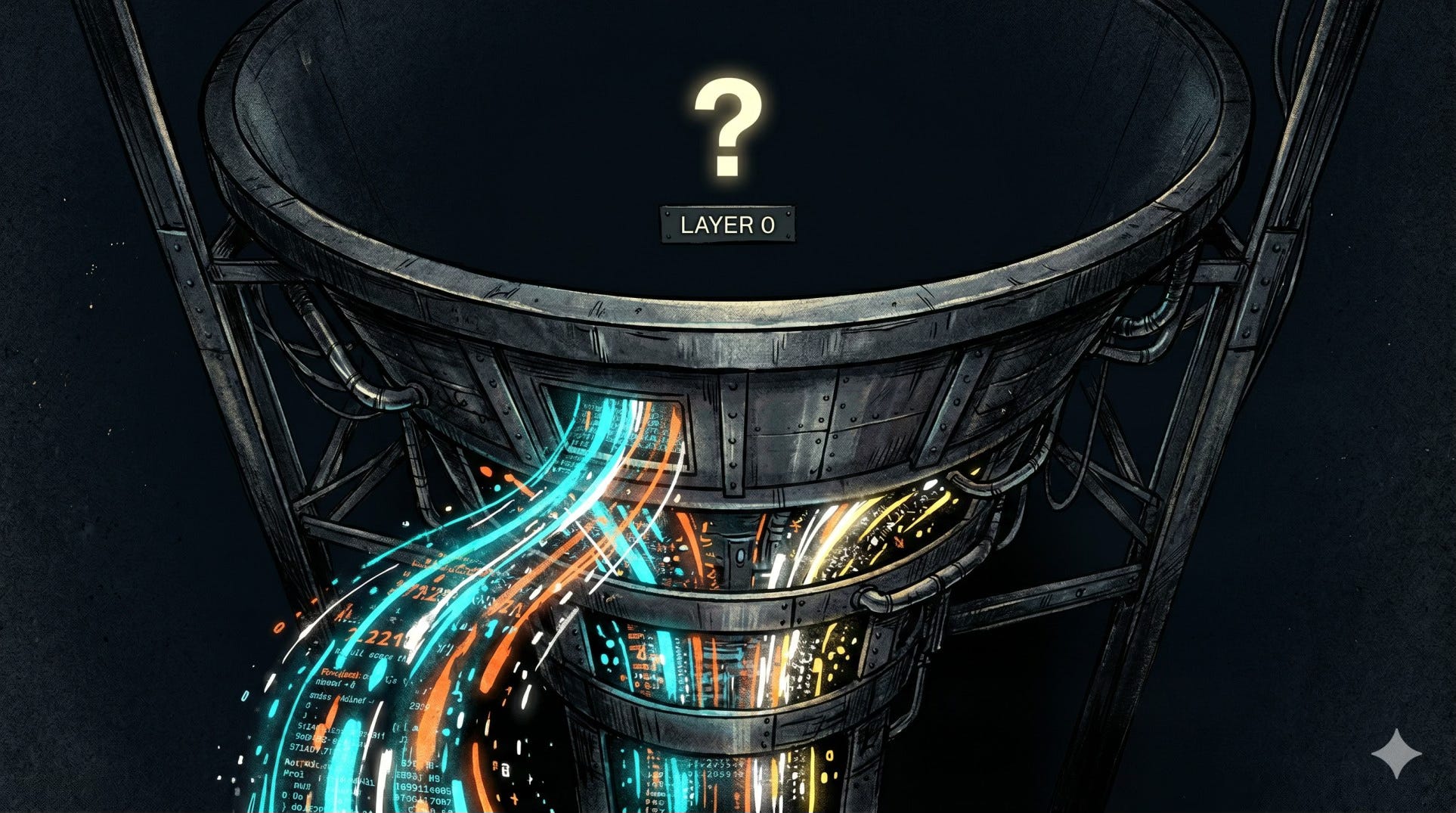
THE R&D FUNNEL — WHERE AI IS BEING APPLIED
Before the funnel
What should we build? Which direction is worth pursuing? not covered
Design generation
Generate candidates within a chosen design space - McKinsey ✓
Research operations
Accelerate literature synthesis, data access, collaboration - McKinsey ✓
Design evaluation
Faster simulation, surrogate models, prototype assessment - McKinsey ✓
The layer above the funnel — the decision that determines which direction to pour resources into — is untouched.
WHY THIS MATTERS MORE THAN THROUGHPUT
Here is the uncomfortable truth about R&D productivity.
The 80× decline McKinsey documented in pharma is not primarily a throughput problem. Drug companies are running more trials than ever. They’re generating more candidates than ever. The failure rate is staying stubbornly high because the candidates are wrong at the direction level — not the execution level.
The semiconductor paradox is identical. More R&D spend per performance gain is not because the fabs are inefficient. It’s because finding the next node requires exploring a vastly larger design space — and most of that exploration is pointed in the wrong direction before it starts.
Faster throughput on a wrong direction does not improve the outcome. It accelerates the write-off.
“Speed is a strategy — but successful pilots are no guarantee of success. Too many companies end up in pilot purgatory.”— McKinsey, The Next Innovation Revolution, 2025
McKinsey notes this obliquely. But they don’t name the upstream decision as a distinct layer requiring its own intelligence infrastructure.
That is the gap.
THE MISSING LAYER — WHAT IT ACTUALLY IS
The question that the McKinsey framework doesn’t ask is the one that determines whether every downstream investment compounds or collapses:
What should we build — before we commit the resources to build it?
This is not a simple question. For a Fortune 500 engineering team, it involves: identifying which of 2,500 potential design directions are physically feasible before simulation begins; discovering whether the governing physics of your challenge has already been solved in an adjacent domain; eliminating concepts that violate first-principles constraints before they consume engineering months; and building a defensible evidence base for why this direction, not that one, before $50M is committed.
None of this is design generation. None of it is research operations as McKinsey defines it. None of it is design evaluation.
It is upstream direction intelligence. And it does not exist as a category in their framework — because it barely exists as a category in the market.
WHAT THIS LOOKS LIKE IN PRACTICE
A Fortune 500 automotive OEM came to us with a battery thermal management challenge. Their team had been searching for solutions for months — reading automotive literature, running simulations, exploring incremental variants of known approaches.
The KRAFT approach: search by governing physics equation across 42 industries simultaneously.
The Nusselt-Reynolds-Prandtl relationship that governs thermal management in automotive batteries is the same equation that governed satellite thermal management in aerospace cooling research from the 1980s. Different vocabulary. Same physics. Solutions that the battery team had never found — because they were searching by domain, not by law.
Four weeks. Patent-ready concepts. The breakthrough was upstream — before a single new simulation ran.
McKinsey’s framework would have helped them run the simulations faster. It would not have told them which direction to simulate.
COMPLETING THE FRAMEWORK
The McKinsey thesis is not wrong. Doubling R&D throughput via AI is achievable and valuable. The four levers they identify — moving quickly, rewiring the organisation, building model competency, keeping humans in the loop — are all correct.
But the complete framework has one more layer at the top:
THE COMPLETE R&D AI STACK
Layer 0 — Upstream direction intelligence
Physics-constrained discovery across domains. Governing equation search. Concept validation before simulation. This determines which direction to pursue.
Layer 1 — Design generation
Generate candidates within the chosen direction. McKinsey’s first lever.
Layer 2 — Research operations
Accelerate literature, data, collaboration. McKinsey’s second lever.
Layer 3 — Design evaluation
Faster simulation, surrogate models, assessment. McKinsey’s third lever.
Layer 0 is not a small addition. It changes the value equation for every layer below it. Better downstream execution on the right direction compounds. Better downstream execution on the wrong direction is expensive noise.
McKinsey’s $360–560 billion estimate is conservative for exactly the reason they acknowledge: they haven’t attempted to quantify the value of AI enabling breakthrough innovations that transform markets. That value lives at Layer 0.
THE QUESTION THAT DETERMINES EVERYTHING
The McKinsey report closes with this observation from their R&D Leaders Forum:
“This is a critical moment where we will be left behind if we don’t develop AI capabilities in engineering.” — R&D Leaders Forum, 2025
They’re right about the urgency. The innovation revolution is here.
But the AI capability that will determine who leads that revolution is not faster design generation or better simulation surrogates. Those will commoditize — quickly, and cheaply.
The durable capability is knowing what to build before you build it.
That’s the layer McKinsey measured the problem from. But didn’t start the solution at. And that gap — between diagnosing a productivity crisis and solving the upstream decision that drives it — is exactly where the next decade of R&D advantage will be built.
KRAFT is the upstream intelligence layer — built for engineering teams deciding what to build before simulation begins.
If this framing resonates, subscribe — I write about upstream R&D intelligence, physics-constrained AI, and the decisions that determine whether engineering programmes succeed or fail.
Sridhar DP is the Founder of KREAT, building KRAFT — upstream R&D intelligence for engineering teams.